Escape from Playtime Lore: Story, The Voice & Canon Explained
Break down the Escape from Playtime lore: The Voice, A Better Place, the Smiling Critters, and how the spinoff connects to Poppy Playtime canon.
Escape from Playtime lore is quickly becoming one of the most debated topics in the Poppy Playtime community, and for good reason. Mob Entertainment's upcoming co-op horror spinoff isn't just a side project — it's officially canon, serving as a prequel that reveals what happened inside Playtime Co. after the Hour of Joy. Instead of playing as a human protagonist, you inhabit the furry bodies of the Mini Smiling Critters, sent scurrying through a procedurally generated toy factory by a mysterious entity known only as The Voice.
That premise alone raises big questions. Who — or what — is The Voice? What is "A Better Place" that the Critters are being forced to build? And how does this all slot into the timeline of the mainline games? Let's dig into everything we know about the Escape from Playtime lore so far, from confirmed story details to the breadcrumbs players have already started uncovering.
What Is Escape From Playtime?
Escape from Playtime (EFP) was first teased under the codename "Experiment 82626," a deliberately opaque branding choice designed to keep the plot under wraps. The game was officially revealed during the 2026 Gamescom Future Games Show, and it hits Early Access on October 21, 2026.
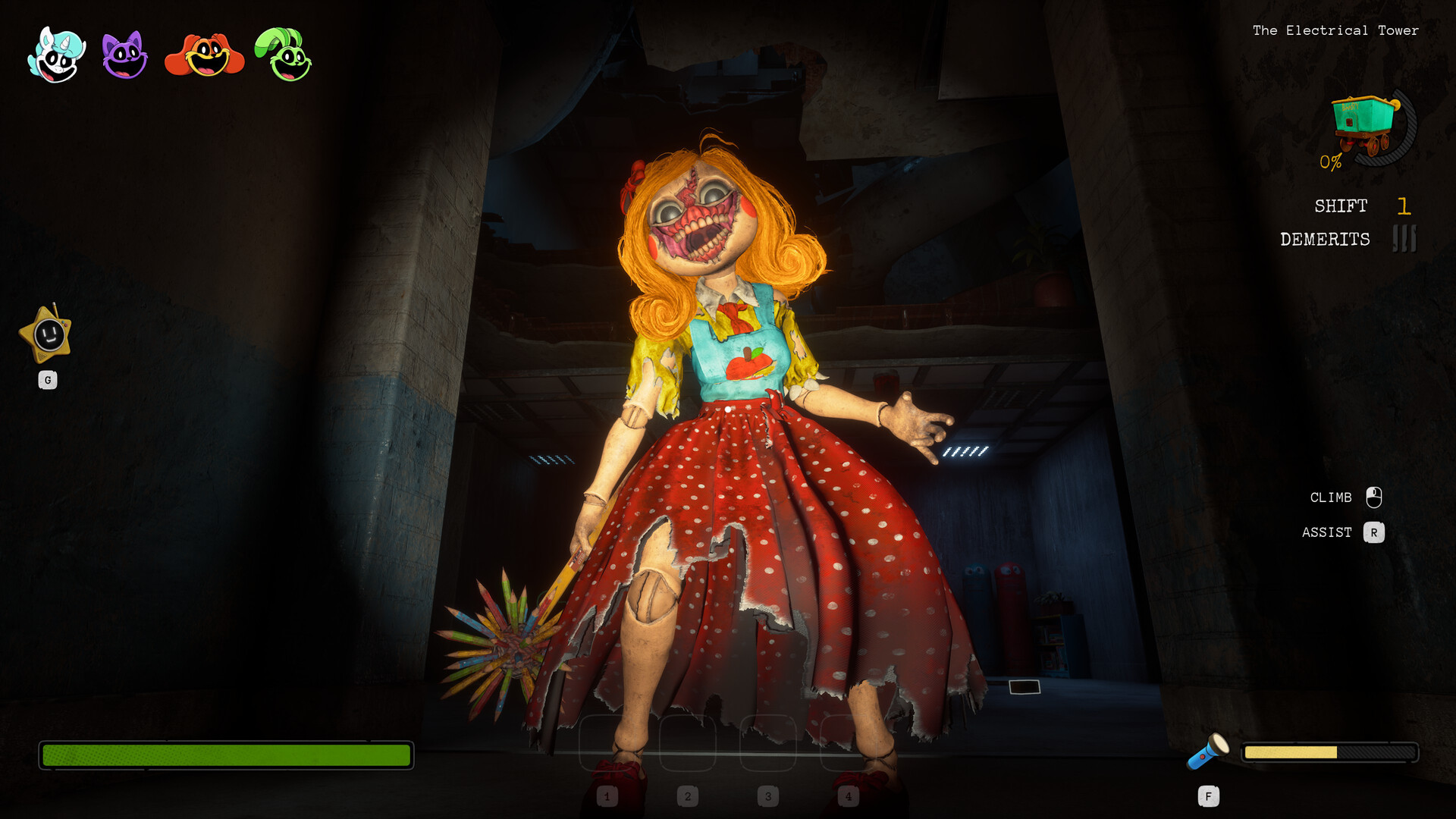
Official screenshot · Source: Steam store
According to the official Steam page, it's a 1–4 player co-op survival horror experience set deep inside the abandoned Playtime Co. factory. Players control the Smiling Critters — the dead-eyed, permanently grinning toy line introduced in Poppy Playtime: Chapter 3 — from a shrunken, critter's-eye view.
| Quick Facts | Details |
|---|---|
| Developer | Mob Entertainment (separate team from the mainline game) |
| Genre | Co-op survival horror / extraction looter |
| Players | 1–4 (solo supported, no matchmaking) |
| Canon status | Officially canon, prequel to Poppy Playtime |
| Timeline | Set after The Hour of Joy |
| Early Access launch | October 21, 2026 |
| Launch roster | Full eight-character Smiling Critters lineup |
The Story So Far: The Voice and A Better Place
The central narrative hook of the game is deceptively simple. A mysterious Voice commands the Mini Smiling Critters to scavenge parts and resources scattered across the factory and haul them back to Barry, a googly-eyed collection cart. Those materials feed the construction of "A Better Place" — a promised sanctuary for toys who prove their loyalty and usefulness.
Of course, nothing in the Poppy Playtime universe is ever that wholesome. The Steam description practically winks at the camera: "try not to ask too loudly who or what you are really working for." The Voice promises freedom and a home, but its true motives remain deliberately unclear.
Key Story Elements at a Glance
| Element | What We Know | Open Questions |
|---|---|---|
| The Voice | Commands Critters to gather resources | Identity, motives, connection to established villains |
| A Better Place | A promised home built from scavenged parts | What is it actually being built for? |
| Barry | The loot cart Critters must deliver resources to | Just a tool, or something more? |
| The Critters | Sentient experiments based on the 1989 toy line | What happened to the "real" Critters from Chapter 3? |
| The Hour of Joy | The game takes place after this massacre event | How does the factory still function? |
The tagline found on the game's original Steam listing — "What's the time? We're nearly home…" — is a chilling inversion of Playtime Co.'s real slogan, "What's the time? Playtime!" For lore hunters, that single line suggests the Critters genuinely believe salvation is waiting at the end of their labor. Tragedy feels baked into the premise.
Where Escape From Playtime Sits in the Timeline
Canon placement matters enormously to this community, and Mob has confirmed the game takes place after The Hour of Joy — the catastrophic event in which the factory's toy experiments turned on their human creators. That makes EFP a bridge story: the humans are gone, the monsters roam, and something is now directing the surviving toys.
A few timeline implications worth noting:
- The factory is abandoned but active — classrooms, warehouses, and testing labs still shift and rearrange, allegedly altered by The Voice itself.
- The enemies you dodge — Miss Delight, Boogie Bots, Cat-Bees — are "rejected Playtime Co. creations," meaning the facility's darker experiments survived the uprising.
- Because the Critters are experiments "based on" the 1989 toy line rather than the specific mascots from Chapter 3, the game may be filling in what happened to the smaller, miniaturized versions of these characters.
Notably, binary code hidden in one of the Steam images decodes to "Work, and you will earn your place." Community reports also flagged that cryptic lore tweets posted by Mob Entertainment in the lead-up to reveal may have been written from The Voice's perspective — though that remains unconfirmed.
The Enemies and What They Reveal About the Lore
The monster roster doubles as a tour of Playtime Co.'s failures. Each enemy type demands a different survival strategy, and each one hints at the company's twisted experimentation.
| Enemy | Behavior | Lore Significance |
|---|---|---|
| Miss Delight | Wanders halls slowly, BioShock Big Daddy-style menace | Fan-favorite, seemingly the main antagonist |
| Boogie Bots | Patrol loops, sound alarms, charge and explode | Factory security systems still operational |
| Cat-Bees | Float like ghosts, latch on and drain health | Swap-imals line, another "rejected creation" |
| Fourth enemy type | Confirmed but unrevealed | Data miners suggest Huggy Wuggy, Boxy Boo, and DogDay are coming |
Community reports from the open beta's game files claim folders reference future monsters including Huggy Wuggy and DogDay, plus a "DecontaminationZones" location tied to a possible Chapter 6 prototype. Treat those as rumors until officially confirmed — but they suggest the lore pipeline between EFP and the mainline games runs both ways.
How Gameplay Reinforces the Story
What makes the Escape from Playtime lore interesting is how tightly the mechanics are welded to the narrative. This is a horror game with no direct combat, which forces you into the mindset of a small, vulnerable toy rather than an action hero.
Player experience from the recent playtests highlights the loop:
| Shift Mechanic | How It Works | Story Function |
|---|---|---|
| Loot quotas | Each shift requires minimum points to escape | The Voice's endless, escalating demands |
| Escalating difficulty | Maps grow larger, hazards multiply | The factory (and the task) is never satisfied |
| Deteriorating safety | Monsters get sharper, toxic red catnip gas spreads | Time in the factory is literally killing you |
| Utility items | Glow sticks, air horns, four inventory slots | Improvised survival as a tiny toy |
| Co-op puzzles | Giant piano-key rooms demand teamwork | "Friendship lights the way" — the Critters' motto, weaponized |
That last row deserves attention. The Smiling Critters' in-universe slogan about friendship and teamwork becomes a survival mechanic here — you literally cannot progress efficiently alone. Whether that's heartwarming or horrifying depends on how much you trust The Voice, which is exactly the tonal blend Mob is aiming for.
IGN's hands-on preview praised the game as "surprisingly challenging in mostly fun ways," noting that the developers have paid careful attention to keeping environments and enemies accurate to the established world while leaving "breadcrumbs for the real lore heads to devour."
Lore Breadcrumbs, ARGs, and Community Theories
Mob Entertainment has a history of seeding ARGs (alternate reality games) around its releases, and EFP's marketing followed suit:
- Hourly cryptic lore tweets on August 24–25, ending with "We're nearly home..."
- The "Experiment 82626" codename and hidden binary messages
- Promotional videos embedded in live streams, including footage of the developers playing inside a recognizable factory room
- Beta file discoveries suggesting future content ties directly into the wider story
Popular community theories currently circulating include:
- The Voice is a known entity. Candidates range from The Prototype (Experiment 1006) to a corrupted recording system, given the franchise's love of broadcast-based manipulation.
- A Better Place is a trap. The Critters' labor may be constructing something for the benefit of a much larger experiment — possibly feeding directly into events players witness in later Poppy Playtime chapters.
- The mini Critters are expendable prototypes. Their "earning a place" framing mirrors the Bigger Bodies Initiative's utilitarian cruelty.
None of these are confirmed, but the developers have openly stated the 1.0 version will add "lore and story" alongside new content, and that Early Access will run roughly a year while shaped by community feedback. The story is very much still being written — in some cases, with the fans' help.
FAQ
Is Escape from Playtime canon to the Poppy Playtime story?
Yes. Mob Entertainment has confirmed the game is officially canon and functions as a prequel set after The Hour of Joy, with events that connect to the larger Poppy Playtime narrative.
Who is The Voice in Escape from Playtime?
The Voice is the mysterious entity commanding the Mini Smiling Critters to collect resources and build "A Better Place." Its identity and true motives are unconfirmed — that mystery is the core of the Escape from Playtime lore.
When does Escape from Playtime release?
The game enters Early Access on October 21, 2026 on Steam, launching with the full eight-Critter roster, one starter zone, and a core enemy lineup.
Can you play Escape from Playtime solo?
Yes, the game supports solo play, though it's designed around 1–4 player co-op with proximity voice chat, and many objectives — like the piano puzzle rooms — are significantly easier with friends.
The factory doors open on October 21. Whether A Better Place is real or just another lie echoing through Playtime Co.'s halls is a question only the shifts will answer.
Related Guides
Escape from Playtime Mysterious Voice: Lore Explained
Who is the mysterious Voice in Escape from Playtime? Break down every trailer line, the Boxy Boo connection, and what it means for Poppy Playtime lore.
Escape from Playtime Story: Plot, Lore & Co-Op Explained
Break down the Escape from Playtime story: The Voice, the Smiling Critters, Barry, and how the co-op horror plot ties into Poppy Playtime lore.
Escape from Playtime Theory: What the Voice Really Wants
Dig into the biggest Escape from Playtime theories — the Voice, the Prototype, A Better Place, and hidden beta files — before the October 21 launch.