Escape from Playtime age rating: parent content guide
No ESRB or PEGI age rating is listed for this horror co-op. See voice-chat risks, scare tone, and who it actually fits.
Parents who search for an Escape from Playtime age rating are usually trying to stop a cute character design from making the decision for them. Escape from Playtime age rating boxes from the ESRB or PEGI do not appear on the Steam listing or in the pinned developer FAQ behind this guide, so there is no official letter to repeat. The game that launched into Early Access is a co-op survival horror set inside the Poppy Playtime factory, and the people you play with can talk through proximity voice chat.
That mix matters more than the plush faces. Smiling Critters are the playable cast, but the job is to grab parts for a mysterious Voice and get out before rejected toys turn the run into a hunt. Early Access also means the scares, jokes, and online tools are still moving. A family decision made from the key art alone will be the wrong one.
What families are actually buying
On Steam, the game is presented as a Smiling Critters adventure: co-op survival horror in the Poppy Playtime universe. You explore classrooms, warehouses, labs, and the corridors between them while rejected Playtime Co. creations hunt the group. Layouts change from run to run. Players look for tools, clues, hiding spots, and side paths, then haul resources back. A Perm-A-Lounge computer tracks progress and is framed as another window into company secrets.
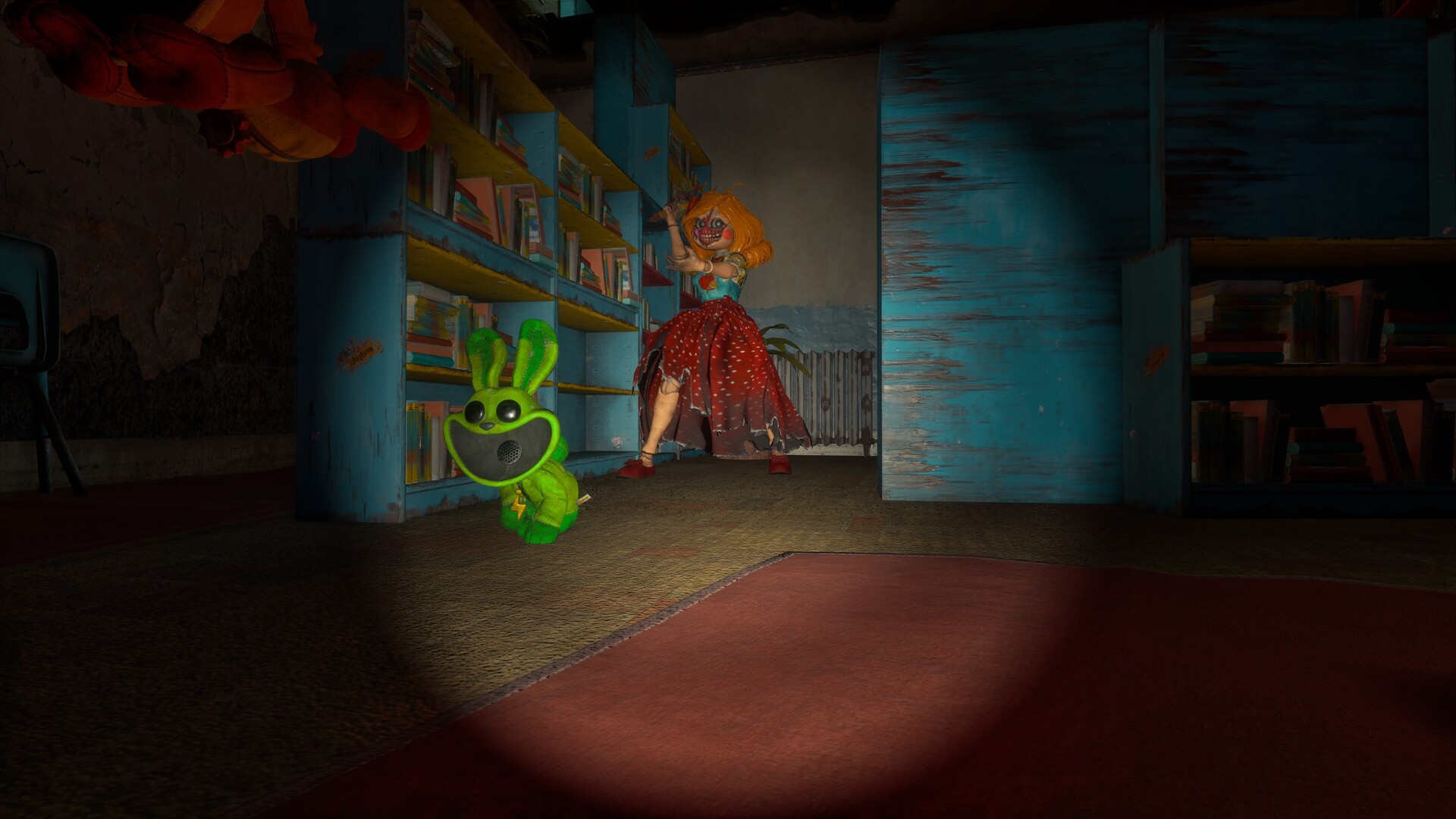
Official screenshot · Source: Steam store
Mob Entertainment shipped it on Steam for Windows as Early Access. A pinned developer FAQ lists October 21, 2026 as the release date, and launch footage is already billed as out now. That FAQ says Early Access is aimed at roughly a year, until the core feels solid with the community, and that version 1.0 should add content, balance, fixes, performance, hardware support, and story. The developers also plan to raise the price once that fuller version arrives.
The store page behind this guide showed a $9.99 list price and an introductory 10 percent cut to $8.99 through November 4, 2026. Tax and region can change the checkout number. It is not free, despite community posts asking for a giveaway. Bundle listings that pair it with other horror games are another signal about the audience the page expects.
| Detail | What the current materials show |
|---|---|
| Status | Early Access on Steam; developer FAQ dates the release to October 21, 2026 |
| Price | $9.99 list; intro price $8.99 through November 4, 2026; higher price planned at 1.0 |
| Platform | Windows 10 or 11; no Linux or macOS at launch; consoles and phones not confirmed |
| Group size | Store text says 2–8 players; earlier FAQ says 1–4, including solo |
| Age-board label | Not shown on the store excerpt or in the FAQ |
| Online flag | Steam lists in-game chat and online interactivity |
The hardware bar is its own kind of clue. This is not a tablet toy. Minimum play calls for 8 GB of RAM and a graphics card on the order of a GeForce GTX 1650 or Radeon RX 470. The recommended PC moves to 16 GB and a much stronger card. Steam Deck compatibility was listed as unknown. If the only screen at home is a phone, the platform question ends the age question.
Where the Escape from Playtime age rating stands today
Until a ratings board publishes one, nobody can honestly quote an official Escape from Playtime age rating. The store text flags interactive elements, then names in-game chat and online interactivity. It does not itemize blood, language, or violence the way a finished ESRB summary would. The developer FAQ covers solo play, specs, lore, and Early Access plans, and it never assigns a recommended age.
A missing label is not a child-safe certificate. It only means you have to read the product. The place to re-check is the Escape from Playtime page on Steam, because Early Access notes and content lines can change without a separate announcement.
Parents who already know the Poppy Playtime chapters should not paste that memory onto this spinoff. Those chapters are story-led horror. This release is a repeatable co-op loop, with shifting rooms and a Voice telling you to bring materials back. The FAQ says a separate team is building it, so it is not the chapter schedule under a new name. Shared toys do not guarantee the same intensity, session length, or online behavior.
| Topic | Steam store listing | Pinned developer FAQ |
|---|---|---|
| Party size | Up to seven friends, described as 2–8 players | One to four players, and solo is allowed |
| Chat | Interactive-elements warning cites in-game chat | Says there is no in-game chat, then explains proximity voice |
| Age guidance | No ESRB, PEGI, or similar label in the page text | No recommended age in the answers |
| Other devices | Deck compatibility unknown; Windows specs only | Windows 10/11 only; consoles or mobile might be explored later |
| Launch scope | Full eight-character roster, one starter zone, a core enemy lineup | More content later, shaped with community feedback |
When two official lines disagree, plan for the stricter one. If the store allows a group of eight, assume a crowd is possible. If the FAQ denies typed chat but describes proximity voice, assume microphones. A gap between a late-summer FAQ and an October store page is a reason to trust the live page for features, and to trust neither page for an invented age number.
Content themes that should shape your decision
Searching for an Escape from Playtime age rating really means scoring the tone, not counting how cute the key art is. You play a Smiling Critter and move through spaces series fans may recognize, from a smaller point of view. Other rejected creations stalk those halls. Because the Voice seems to rearrange the factory, you cannot memorize one safe route and turn the game into a calm tour.
The launch promo makes the humor plain. The group splits up in the dark, a flashlight begins to fail, and the players talk about needing a sacrifice. The joke then turns on consuming a teammate for a speed boost while that person begs not to be abandoned. You do not need a gore montage to read the mood. Danger is the punchline, and being left behind is part of the bit. A lot of younger children will not file that under comedy.
The lore sits heavier than the models. The FAQ traces the Smiling Critters to a plush line tied to a cartoon in Poppy Playtime Chapter 3. CatNap was recalled because gas meant to calm children caused nightmares, and that same gas was used to put Playcare’s orphans to sleep. This spinoff is set sometime after the Hour of Joy, when the toy experiments turned on the staff. That history does not have to play as the opening cutscene to be one search away. Kids who love the characters will go looking.
These sources do not support a precise claim about blood, injury close-ups, or sexual content. Those details are simply not listed. Do not let a forum guess fill the blank, and do not treat a missing descriptor as proof that the game is mild. Pursuit, morbid jokes, and grim company history are already enough to screen on.
| Content piece | What you can verify | Why it matters for age |
|---|---|---|
| Character look | Playable Smiling Critters in familiar factory spaces | Can trick a child into expecting a cartoon |
| Goal | Collect parts for a mysterious Voice and get out | Stress, and a narrator you are told not to question too loudly |
| Danger | Rejected creations hunt players through shifting maps | Hide-and-chase horror is the main activity |
| Promo tone | Sacrifice jokes and a teammate left behind | Morbid humor, not slapstick |
| Series lore | Nightmare gas, Playcare, a post–Hour of Joy setting | Backstory is bleak if curiosity leads off the game |
| Unlisted details | No blood or intimacy breakdown in these sources | Unknown is not the same as absent |
Community reports show the same tug-of-war. One player praised the cute cast and the horror together, then asked whether a younger cartoon without the scares would exist. Others asked which chapter monsters would appear. Those are player questions, not a confirmed roster. The store only commits to a core enemy lineup in a starter zone, with more zones and threats depending on feedback.
Voice chat, party size, and online safety
Voice chat changes the Escape from Playtime age rating question more than any missing letter on the store page. Proximity chat makes nearby people loud and distant people faint. The FAQ says a microphone is optional, that play is better when the group can talk, and that typed in-game chat is not a feature. Steam still warns about in-game chat and online interactivity. Taken together: typed chat may be absent, live voices are designed in, and online play is expected.
A trailer can be previewed. A stranger’s microphone cannot. Even if scripted lines stay relatively mild, a public room can include swearing, insults, or jokes harsher than the sacrifice bit. The promo already treats harming a teammate as a buff, and some groups will copy that energy. Community posts hunting for extra players are a reminder that open groups are how many people expect to fill a lobby.
Party size is unsettled enough to plan around. The earlier FAQ describes a 1–4 player game, says a brave person can go alone, and pitches up to three friends. The store About text instead offers up to seven friends in a 2–8 player run, and notes that more critters mean more ways for the run to go wrong. Solo, if it is still offered, cuts stranger risk. An eight-player public room maximizes it. Confirm the mode on the live page the day you install. Do not put a child in a public room while that answer is still a guess.
A few habits cover most of the risk:
- Watch the launch footage together before anyone installs the game.
- Choose people you already know over open groups.
- Skip voice until you trust the room. The developer says a mic is optional.
- Sit where you can hear proximity chat, not just the music.
- Leave if the jokes turn on a player. The tone already invites that.
- Look again after large updates. A year of Early Access can add maps, enemies, and social tools.
Spoken language support is narrower than the scare factor. English is marked for full audio. French, Italian, German, and Spanish (Spain) are marked for interface and subtitles, not full speech. A child who cannot follow spoken English may miss teammate warnings and still catch every frightening sound.
Age-by-age guidance you can use this week
The table below is a family screening guide, not an official Escape from Playtime age rating. If a board later assigns a letter, use that letter, then still account for live chat. Rating summaries often say little about who else is in the lobby.
| Age group | Editorial fit | What to do instead of guessing |
|---|---|---|
| Under 10 | Poor fit | Skip it. Plush art is not a promise of gentle play. |
| 10–12 | Only with a parent involved | Friends only, no public voice, and stop if fear or mean jokes linger |
| 13–15 | Reasonable for teens who already handle toy horror | Private groups first, and watch one full run before longer sessions |
| 16 and older | Closest match to regular co-op horror players | Open mics still deserve the same care as any online game |
Under 10, the mismatch is the whole product. A dying light, an unclear Voice, and jokes about sacrificing a friend are a bad trade for a child who wanted a critter cartoon. The Playcare and Hour of Joy references are the wrong rabbit hole.
Ages 10 to 12 are the hard call, because many kids that age already watch horror-adjacent clips. Curiosity is not comfort. If you try a session, be in it, keep the group to friends, and let one bad round end the test. Clips on a phone are not proof a child can handle live multiplayer.
Teens about 13 to 15 are the first range where families have often already weighed this universe’s toy horror. Compare the spinoff with a chapter they finished beside you, not with a clip they scrolled past. Procedural runs can feel longer and meaner than a story level with no audience. Sixteen and up is where the co-op structure, including gallows humor, usually aims. Being old enough for the tone does not make a random lobby kind.
If the screen is a yes, the published minimum PC is 64-bit Windows 10 or 11, 8 GB of memory, a GTX 1650-class or RX 470-class GPU, and DirectX 12. The recommended tier is 16 GB and a high-end card such as an RTX 3070 or RX 6800 XT. Both the store page and the FAQ list those figures.
| Component | Minimum | Recommended |
|---|---|---|
| System | 64-bit Windows 10/11 | 64-bit Windows 10/11 |
| Processor | Intel Core i3-9100 or AMD Ryzen 5 3500 | Intel Core i9-11900K or AMD Ryzen 9 5900X |
| Memory | 8 GB RAM | 16 GB RAM |
| Graphics | GeForce GTX 1650 or Radeon RX 470 | GeForce RTX 3070 or Radeon RX 6800 XT |
| DirectX | Version 12 | Version 12 |
An intro discount does not freeze the content. Feedback is supposed to drive features, items, characters, and balance, and 1.0 is planned to cost more after that work lands. A starter zone that feels acceptable can feel harsher once new enemies arrive. Reconsider younger teens at the next large update, not only on download day.
If you keep one line, keep this: there is still no published Escape from Playtime age rating to hide behind. Cute critters, horror chases, morbid team jokes, and live proximity chat are the four facts that should decide it.
FAQ
Is there an official Escape from Playtime age rating?
No ESRB, PEGI, or similar rating appears in the Steam store text or the pinned developer FAQ used here. The only formal content note is Steam’s warning for in-game chat and online interactivity. That flag is about playing with other people, not a full review of scares, humor, or story. Check the store page again after large Early Access updates in case a board label shows up later.
Can younger kids play because the Smiling Critters look friendly?
The characters are not a green light. They come from a horror series, and here they are the bodies you use while other creations hunt you. The factory, the mysterious Voice, and promo jokes about sacrificing a teammate are built for tension. A community comment even asked for a non-horror cartoon for younger viewers. The developer FAQ does not promise that gentler spinoff.
Will strangers be able to talk to my child?
They might, if your child joins other players. The FAQ says a microphone is optional and that typed chat is not included, while proximity voice makes nearby people easier to hear. Steam still marks in-game chat and online play. Scripted lines and live voices are different risks. Keep children and younger teens with people you know, or skip voice, until public rooms are clearly avoidable.
Is this the same game as the Poppy Playtime chapters?
It shares the universe and, per the developer FAQ, takes place sometime after the Hour of Joy. It is not one of the story chapters. Mob Entertainment says a separate team is making it so those chapters are not delayed. You get repeatable co-op runs, a starter zone, and procedural layouts, with more content planned across about a year of Early Access. Knowing the chapters helps with names. It does not settle the age question by itself.
Related Guides
Escape from Playtime Beginner Guide: Tips & Basics
Learn the basics of Escape from Playtime — objectives, monsters, items, stamina, and escape routes in this complete beginner guide for new critters.
Escape from Playtime Bosses: Complete Guide & Strategies
Learn how every boss encounter works in Escape from Playtime. Full walkthrough tips, chase strategies, and survival tricks for all major bosses.
Escape from Playtime Ending Explained: How to Win Runs
Break down the Escape from Playtime ending, the final Boogie Bot escape sequence, quota system, and tips to survive your run and reach the top.
Escape from Playtime How to Play: Beginner's Survival Guide
Learn how to play Escape from Playtime — tribute goals, extraction loops, stamina, monsters, and solo vs co-op tips for surviving the factory.